
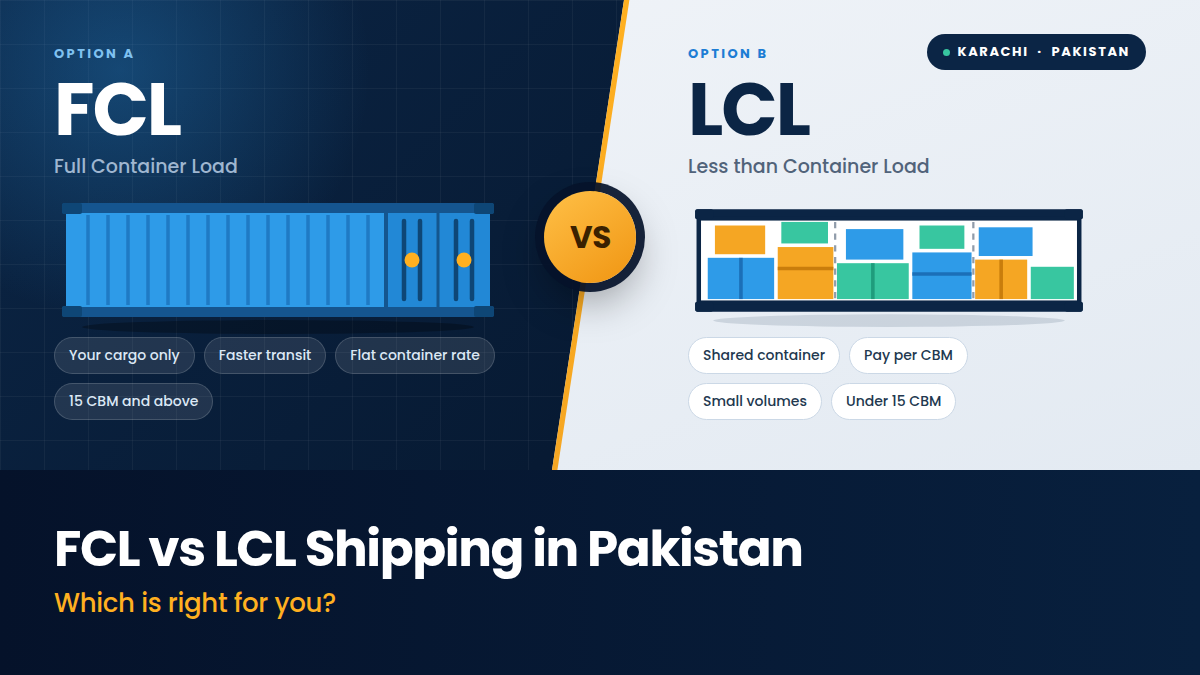
 FCL vs LCL Shipping in Pakistan: Which Is Right for You?
 9/14/2026 3:10:55 AM
FCL vs LCL Shipping in Pakistan: Which Is Right for You?
When businesses start planning an international sea shipment, one question usually comes up early: should the cargo move as FCL or LCL? At first glance, the difference seems simple. FCL gives you a full container, while LCL allows you to share container space with other shipments. However, once cost, cargo volume, transit time, and handling come into the picture, the choice becomes more important. For importers and exporters in Pakistan, choosing the right option can affect not only the freight bill but also the smoothness of the shipment from origin to destination. Therefore, it helps to understand where each option works best before making a booking.
What Is FCL Shipping?
FCL stands for Full Container Load. In this arrangement, the entire container is booked for one shipper. That does not mean you must fill every inch of the container. Instead, it means the space is reserved exclusively for your cargo. Businesses commonly use 20-foot, 40-foot, and 40-foot high-cube containers, depending on the type and quantity of goods being moved. FCL is often suitable for manufacturers, wholesalers, and businesses shipping larger volumes. Since the cargo stays together inside one dedicated container, there are generally fewer handling stages along the way. As a result, businesses have more control over loading and cargo placement.For shipments involving larger quantities, machinery, raw materials, or sensitive goods, this added control can be valuable.
What Is LCL Shipping?
LCL stands for Less than Container Load. With LCL, your cargo does not occupy an entire container. Instead, it shares space with shipments from other businesses. This option is useful when a shipment is too large for ordinary courier services but still too small to justify paying for a full container. For example, if you are shipping a few pallets, cartons, spare parts or a smaller quantity of commercial stock, LCL may be the more practical choice. You pay for the space your cargo uses rather than the whole container. However, because different shipments travel together, LCL cargo normally undergoes consolidation before departure and deconsolidation at the destination. Consequently, it may involve more handling than FCL.So, What Really Separates FCL from LCL?
The main difference is not simply the container size. It is how that container is used. FCL gives one shipper exclusive use of the container, while LCL combines several shipments in the same space. From there, several other differences follow. FCL usually offers greater control and fewer handling points. LCL, on the other hand, gives businesses more flexibility when their cargo volume is smaller. This is why the decision should not be based on one factor alone. Instead, you need to consider the complete shipment, including how much cargo you have, how quickly it needs to move and how sensitive it is to handling.
When Does LCL Make More Sense?
LCL works best when the shipment is relatively small and filling a complete container would not make financial sense. For instance, a business importing a limited quantity of stock may not want to wait until enough cargo is available to fill a container. In that case, LCL allows the shipment to move earlier without paying for unused space. This flexibility can also benefit businesses testing a new market, sending samples, replenishing stock in smaller quantities or fulfilling smaller commercial orders. In practical terms, LCL may make sense when you have a few pallets, lower cargo volume, or flexible delivery requirements. However, the convenience of sharing container space comes with additional handling, so cargo should be packed accordingly.
When Is FCL the Better Choice?
As cargo volume grows, FCL often becomes the more practical option. Once a shipment begins to occupy a significant portion of a container, paying for exclusive use may offer better overall value than continuing with LCL. Still, volume is not the only reason to choose FCL. Businesses may also prefer FCL when the cargo is fragile, valuable, sensitive or difficult to handle. Since the container is dedicated to one shipment, there is usually less movement of the cargo during consolidation and deconsolidation. Likewise, businesses with regular high-volume imports or exports may find FCL easier to plan because the entire shipment can be loaded together and managed as one unit.
Look Beyond the Freight Rate
Price is often the first thing businesses compare, but this is also where many decisions go wrong. LCL may appear cheaper because you only pay for the space your cargo uses. For smaller shipments, that is often true. However, LCL can also include charges related to consolidation, warehouse handling, documentation, destination processing, and deconsolidation. FCL, meanwhile, involves paying for the full container along with the relevant origin, freight, and destination charges. Therefore, comparing only the ocean freight figure does not give you the full picture. A better approach is to compare the total shipment cost. For example, if your cargo volume is increasing, request both FCL and LCL quotations. In some cases, the difference may be small enough that FCL gives you better value through reduced handling and greater control.
Transit Time Can Influence the Decision
Another important factor is time. FCL cargo usually moves more directly because it does not need to wait for other shipments to be combined with it before departure. LCL involves additional steps. Cargo must first be received and consolidated with other shipments. Then, once the container reaches its destination, those shipments must be separated before moving onward. Because of this, LCL can take longer in some situations. That does not make LCL inefficient. In fact, it works very well for businesses that value flexibility over speed. However, if a shipment is tied to a strict delivery deadline, production schedule, or customer commitment, transit time should be considered alongside cost.
Cargo Handling Matters More Than It Seems
The way cargo is handled during transit can also influence the right shipping method. LCL shipments may pass through several handling points before they reach the final destination. As a result, the cargo can be moved more frequently during consolidation and deconsolidation. For well-packed commercial goods, this is usually manageable. However, fragile or unusually shaped items may require stronger packaging, better strapping, or additional protection. FCL generally reduces these handling points because the cargo stays inside a dedicated container for a larger part of the journey. Even so, proper packaging remains essential for both options. No matter which method you choose, the cargo should be packed according to its weight, dimensions and sensitivity rather than relying on the container itself for protection.
Your Shipping Frequency Also Matters
Sometimes, the right decision is not about one shipment. It is about how your business manages inventory throughout the year. A company that imports stock regularly may prefer LCL because it allows smaller quantities to arrive more frequently. This can help reduce the need to hold large amounts of inventory at one time. On the other hand, a business with stable, high-volume orders may prefer FCL because it can move larger quantities in one shipment and simplify planning. Therefore, it is worth looking beyond the immediate booking. Ask yourself whether your business needs maximum container utilization or greater flexibility. That answer can often point you in the right direction.
FCL vs LCL for Businesses in Pakistan
For Pakistani importers and exporters, both options can be useful depending on the shipment. A manufacturer sending a large export order may prefer FCL, while a smaller business moving a few pallets may benefit from LCL. Similarly, an importer bringing in machinery or larger quantities of stock may need a full container, whereas another business importing smaller batches may prefer shared container space. Before making a decision, review the shipment as a whole. Consider the cargo volume, total weight, number of pallets, origin, destination, required delivery timeline, cargo sensitivity and overall cost. Once these details are clear, the comparison becomes much easier.
Common Mistakes to Avoid
One of the most common mistakes is choosing LCL simply because the shipment looks small.
If the cargo occupies a large amount of container space, FCL may offer better value when all
charges are considered.
Another mistake is focusing only on the basic freight rate. Origin charges, destination handling,
and other service costs can change the final amount significantly.
Businesses also sometimes provide inaccurate dimensions. This can be particularly problematic
with LCL because the amount of space your cargo occupies plays a major role in pricing.
Finally, weak packaging can create avoidable problems. Since LCL cargo is handled more
frequently, proper packaging and labeling become even more important.
How to Choose the Right Option
Before booking, ask yourself a few practical questions.
● How much cargo are you shipping?
● What are the total weight and dimensions?
● How many pallets or packages are involved?
● Is the cargo fragile or sensitive?
● How quickly does it need to arrive?
● Would additional handling create a concern?
● What is the total cost of each option?
Once these questions are answered, the choice between FCL and LCL becomes far more straightforward.
FCL or LCL: Which One Should You Choose?
There is no single winner between FCL and LCL. The LCL is often the better fit for smaller shipments because it gives businesses the flexibility to pay only for the space they need. FCL, meanwhile, is usually more suitable for larger shipments, sensitive cargo or businesses that want exclusive use of a container and fewer handling stages. Ultimately, the right option comes down to your actual shipment rather than a general rule. When volume, cost, timing and cargo requirements are considered together, the decision becomes much easier. Are you planning your next sea freight shipment? Get an estimate from PakPallet and compare the FCL and LCL options to find the one that best fits your cargo.
Frequently Asked Questions
1. What is the difference between FCL and LCL?
FCL gives one shipper exclusive use of a container, while LCL allows several smaller shipments to share the same container.
2. Is FCL cheaper than LCL?
It depends on the cargo volume, route, and overall charges. LCL is usually more economical for smaller shipments, while FCL can become more competitive as volume increases.
3. Can I ship a few pallets through LCL?
Yes. LCL is commonly used for palletised cargo that does not require an entire container.
4. Is FCL faster than LCL?
FCL can sometimes move faster because it does not require consolidation and deconsolidation. However, actual transit time depends on the route, carrier, and sailing schedule.
5. Which option is better for fragile cargo?
FCL may offer an advantage for sensitive cargo because it generally involves fewer handling
stages. However, proper packaging remains important with either method.